
Edition 6 - May, 1999
Edition 6 - May, 1999 |
BCCMTM/LMG, past, present and future |
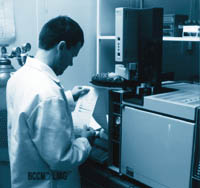 |
BCCMTM/LMG is hosted by the Laboratory of Microbiology of the Faculty of Sciences at the University of Gent, an internationally recognised laboratory in the field of bacterial taxonomy. The close collaboration between BCCMTM/LMG and the university laboratory increases the value of both parties' activities. BCCMTM/LMG curator, Dr Danielle Janssens, explains its history, current role and plans for the future.
BCCMTM
News:
What are bacteria and why are they important?
Danielle Janssens: Bacteria are tiny, unicellular, prokaryotic creatures, that can be thought of as powerful, individual, polyvalent biochemical factories, managing evolution, adaptation, reorganisation and even technology transfer successfully. Although not as appealing as plants and animals, bacteria play a vital role in all aspects of life on earth.
Bacteria provide an inexhaustible source of genes for potential applications in areas such as agriculture, chemistry and pharmaceuticals.
What is the function of culture collections in general·
DJ: Conservation of (microbial) biodiversity has grown in importance over the years, a trend which culminated in the Convention on Biological Diversity (CBD, Rio de Janeiro, 1992; see BCCMTM News 3). The major task of culture collections has always been the ex situ conservation of microbial genetic resources.
·and the BCCMTM/LMG bacteria collection in particular?
DJ: The BCCMTM/LMG bacteria collection has evolved from a research collection of a laboratory specialised in bacterial taxonomy into a research-based service collection, which continues to perform its major task of optimally preserving bacterial species. A collection of nearly 19,000 different cultures, belonging to over 1,300 taxa, is available. Collection and distribution policies are governed by the principles of the CBD (See `MOSAICC', BCCMTM News 3).
The main public collection covers plant-associated or phytopathogenic bacteria, bacteria of medical or veterinary importance, marine bacteria, and various groups of biotechnological interest. Specialist subcollections have resulted from research themes studied by the collection staff or the host laboratory. Among these are the subcollections of marine bacteria, mainly vibrios, lactic acid bacteria, vancomycine resistant enterococci and tropical rhizobiae. These subcollections are available to third parties, subject to specific conditions.
Why is taxonomy important in culture collections' activities?
DJ: Bacterial taxonomy is a complex field of study, which contributes to the understanding of natural relatedness. Qualified taxonomists are needed to provide reliable classification and identification schemes which, in turn, are necessary to assess natural bacterial biodiversity. BCCMTM/LMG scientists are well trained in bacterial taxonomy and their expertise allows the expansion of the BCCMTM/LMG Identification Service beyond the limits of routine commercial identification systems. The collaboration between BCCMTM/LMG and the university laboratory is certainly beneficial in this respect. Our specialist areas are the gram negatives, but we also have expertise in industrially-important gram positives such as Bacillus and the lactic acid bacteria. An identification database, covering 175 taxa of the latter group, is operational.
What other services does BCCMTM/ LMG offer other than distribution and identification of strains?
DJ: The BCCMTM/LMG portfolio includes:
As a recognised International Depositary Authority, BCCMTM/LMG accepts patent deposits (Budapest Treaty) and security deposits (eg European legislation on animal feed additives).
Finally, BCCMTM?/LG is active in several R&D projects, both in the public funding sector and as a confidential contract research partner with individual companies.
What are your plans for the future?
DJ: The BCCMTM/LMG team is improving existing services. An example of this is the expansion of our Identification Service to include additional specialist groups. We also will place more emphasis on two techniques which explore bacterial identification. Firstly, we will increasingly promote the use of the 16S rDNA sequencing technique, in the allocation of an otherwise unidentified strain to its most balanced phylogenetic position (see BCCMTM News 4). This determines its closest relatives and optimises the selection of additional analysis. Secondly, there is an urgent need for ultra fine culture typing at the strain level. In response, we are automating our most discriminating DNA-fingerprint technique, thus increasing throughput.
For other aspects of our services, we encourage our clients to discuss their various needs. We can either provide immediate, specifically tailored assistance, or we can develop new general services.
Finally, BCCMTM appreciates the need for quality management and is collaborating in national and international efforts in this area. Involvement in joint activities on other culture collection issues will be pursued.
Contact BCCM BCCMHome |
Contents Edition 6 - May, 1999 |
Next Article Edition 6 - May, 1999 |