
Science diplomacy (SD) encompasses the interaction between science and diplomacy, through which the two mutually reinforce one another as much as possible through different types of interaction. This occurs when diplomats promote international research and innovation cooperation, when policymakers and diplomats use scientific expertise to inform foreign policy choices and international negotiations, or when scientific cooperation is used to jointly address cross-border and global challenges. Science diplomacy therefore forms a bridge between the world of research and innovation and the world of international relations.
Science diplomacy is not a new phenomenon; however, it has gained considerable importance in recent years. Research cooperation has always played a role in maintaining relations between countries, even during periods of political tension. The current geopolitical context gives SD a more strategic character. Today, science diplomacy is a multifaceted umbrella concept: worldwide, SD is used as an instrument to strengthen international cooperation, protect European interests, promote universal values, and jointly address global challenges.
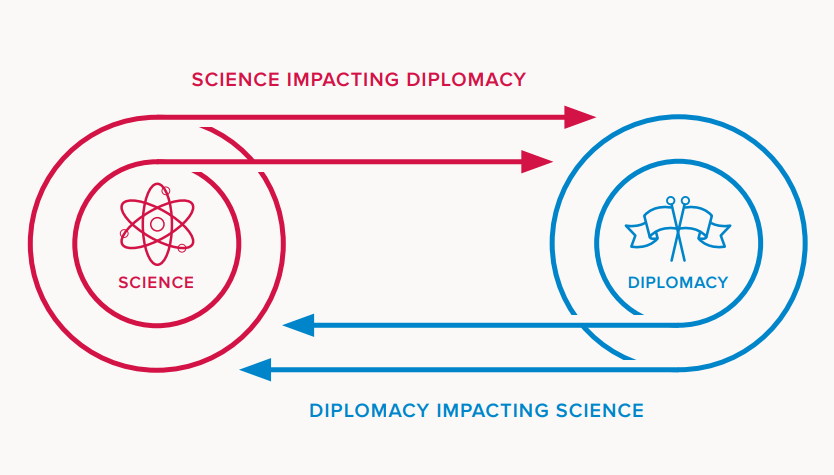
Traditionally, three complementary dimensions of science diplomacy are distinguished, as described by the Royal Society [1]:
The Royal Society & AAAS report Science Diplomacy in an Era of Disruption (2025) [7] provides an important update to the 2010 publication New
Frontiers in Science Diplomacy. It presents a new framework that takes into account the profoundly
changed geopolitical, technological and scientific environment.
More recently, the European Commission, in consultation with the research community, has added a fourth dimension:
Today, research and innovation lie at the heart of our quality of life, economic development and societal resilience. The strength of research and innovation lies in the inspiring diversity of international cooperation that underpins research, technology and innovation (RTI). Science diplomacy supports the international cooperation agenda and is closely connected to the European dialogue on values, open science and international partnerships. At the same time, it contributes to protecting European strategic interests, knowledge security and technological sovereignty.
Research strives for objectivity and truthfulness; its language is therefore, to a certain extent, regarded as universal and relatively neutral, although it can never be entirely detached from geopolitical realities and national strategies. Research cooperation can create trust, help prevent or resolve conflicts, and contribute to sustainable solutions for complex global challenges. It supports socio-economic development, strengthens international competitiveness in research, technology and innovation (RTI), and helps both to protect European knowledge assets and to build research, technology and innovation capacity in less developed regions.
In an increasingly unstable world, keeping international channels of communication open through research and innovation is essential—particularly where traditional diplomacy is under pressure [8] [9].
International examples of joint research infrastructures, in particular, illustrate the connecting role of science. One need only think of the astronauts and cosmonauts working together on the International Space Station (ISS) [10] despite geopolitical tensions between Russia and Western countries, as well as cooperation within ITER and participation in thematic international forums involving countries with which political tensions may exist. The SESAME synchrotron project in Jordan likewise brings together researchers from countries in the Middle East—and beyond—that may be politically opposed to one another, within an inspiring and forward-looking dynamic.
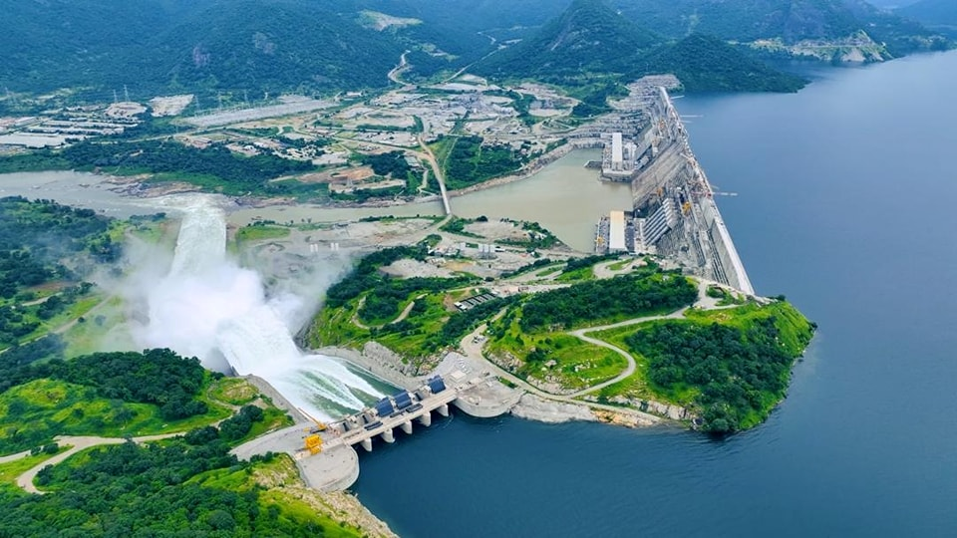
Scientific evidence can also support dialogue concerning shared natural resources, such as in
relation to the water conflict surrounding the Nile [11]
[12]
In 2024, the European Commission, in cooperation with the African Academy of Sciences (AAS), facilitated a
safe space meeting bringing together experts from all Nile Basin countries to exchange knowledge as a form
of trust-building and to provide a possible foundation and impetus for a regional policy dialogue under
less tense conditions.
A previous research project involving experts from the VUB and KU Leuven demonstrated that combining
negotiations on water management with those concerning electricity production and management—rather than
focusing exclusively on the distribution of water—could transform the Nile from a “zero-sum conflict” into
an opportunity for shared benefits, supported by scientific evidence.
From a science diplomacy perspective, this project demonstrates how research can contribute to addressing
complex cross-border challenges. By modelling water management, energy trade, climate and economic impacts
in an integrated manner, science can provide relatively neutral and objective insights capable of
strengthening trust among the countries involved. In this way, science acts as a bridge between research
and diplomacy and supports informed, evidence-based decision-making, regional cooperation and sustainable
solutions to international conflicts.
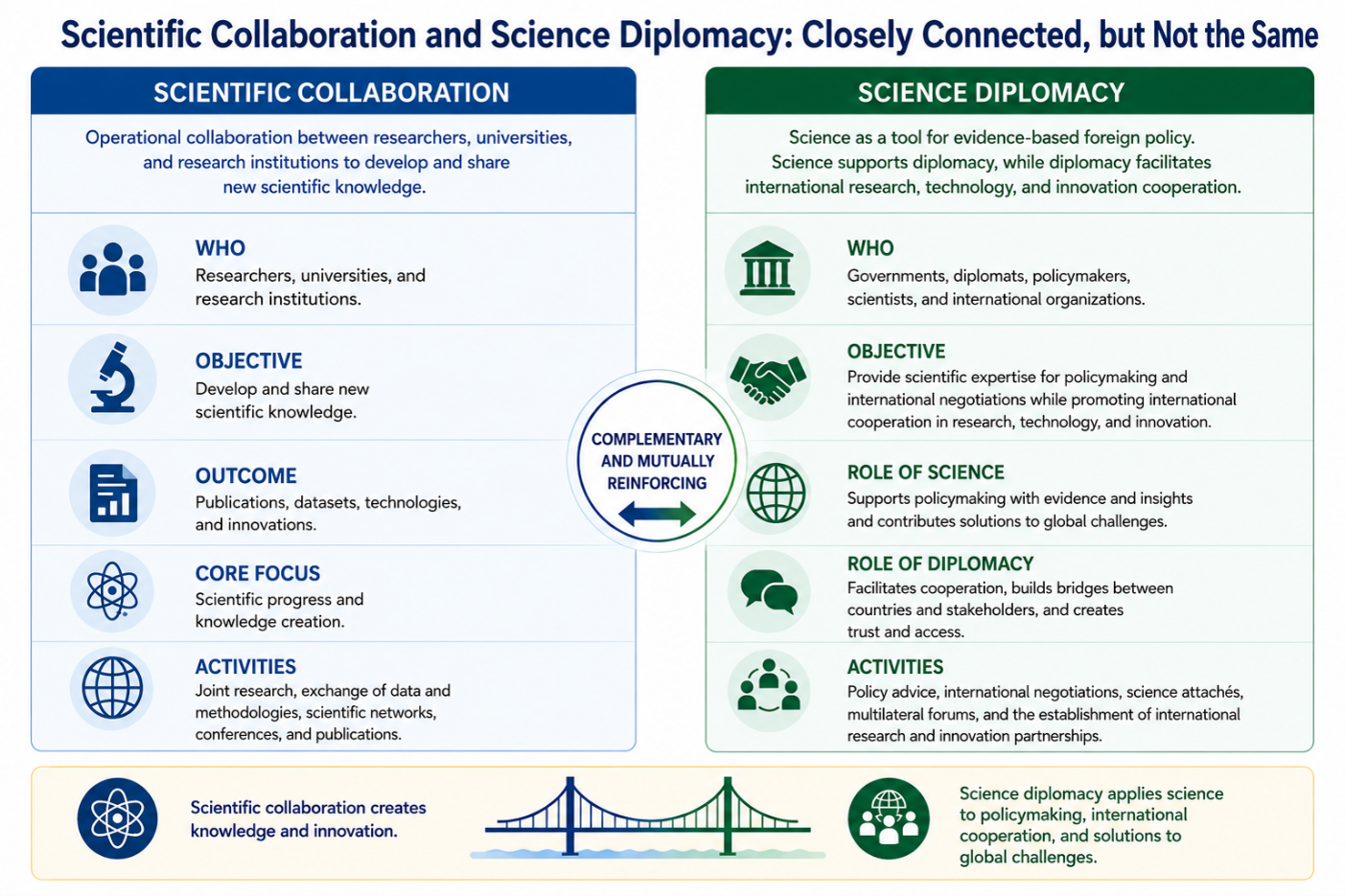
Both concepts are distinct but closely interconnected.
Science diplomacy, by contrast, contributes to well-informed and evidence-based foreign policy and international negotiations by providing knowledge and expertise, while diplomats, in turn, facilitate international cooperation in research, technology and innovation.
Scientific cooperation concerns operational collaboration between researchers, universities and research institutions with the aim of developing and sharing new scientific knowledge. Its results generally consist of publications, datasets, technologies or innovations and are fundamentally aimed at scientific progress.
Science diplomacy increasingly incorporates a strong technological and innovation dimension. In a world in which research is increasingly driven by data and technological developments, science and technology have become closely intertwined in international cooperation [13]. International cooperation concerning artificial intelligence, quantum technologies, semiconductors, cybersecurity, digital governance and other critical technologies has not only scientific and economic implications, but also a clear geopolitical dimension.
The rapid development and diffusion of these technologies offer major opportunities for sustainable development, innovation and prosperity. At the same time, however, they may reinforce existing global inequalities when access to technology, data, infrastructure and knowledge remains unevenly distributed. The ways in which data are collected, shared and used—and who has access to the infrastructure and technologies required to do so—also raise important questions concerning inclusiveness, autonomy and power relations. In this context, warnings have been issued about forms of “algorithmic colonialism”, whereby technological dependencies and unequal access to data and digital infrastructure may perpetuate existing asymmetries [14].
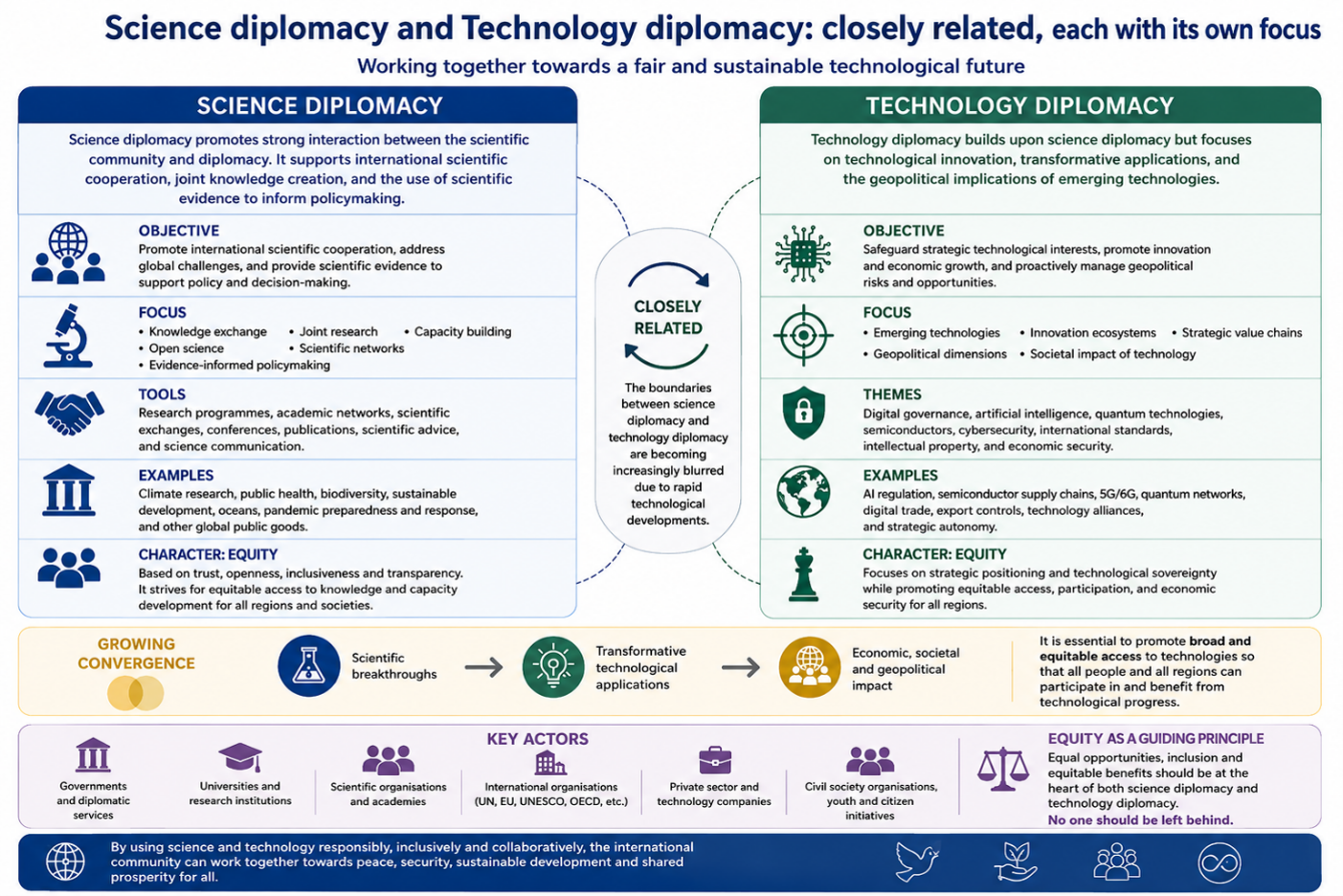
Science diplomacy provides an important instrument for addressing these developments within an international and multilateral context. This involves not only cooperation between researchers, but also dialogue among governments, knowledge institutions, companies and other societal actors concerning the development of, access to and responsible use of emerging technologies. Initiatives aimed at ensuring fair and inclusive access to technological progress, including those developed within UNESCO, are closely connected to this objective. It is essential that all regions of the world and all segments of society are able to participate in—and benefit from—technological progress. In today’s multi-stakeholder diplomacy, major technology companies, policymakers and researchers increasingly sit at the same table. It is therefore crucial that the development and diffusion of these technologies are not driven exclusively by the interests of a limited number of large technology companies.
The growing interconnection between science, technology and geopolitics consequently makes it increasingly difficult—and arguably less desirable—to consider science diplomacy and technology diplomacy as entirely separate domains. [15] [16] [17] [18] [19].
[1] royalsociety.org/news-resources/publications/2010/new-frontiers-science-diplomacy
[2] www.iter.org
[3] www.sarao.ac.za/about/ska
[4] www.sesame.org.jo/about-us/what-is-sesame
[5] www.ipcc.ch
[6] www.ipbes.net
[7] royalsociety.org/-/media/about-us/international/science-diplomacy/science-diplomacy-in-an-era-of-disruption.pdf
[8] link.springer.com/book/10.1007/978-3-319-55104-3
[9] focir.cat/ca/focir-pensament/focir-pensament-3/
[10] www.esa.int/Science_Exploration/Human_and_Robotic_Exploration/International_Space_Station
[11] www.nature.com/articles/s44221-024-00222-9
[12] researchportal.vub.be/en/publications/developing-meaningful-water-energy-food-environment-wefe-nexus-in/
[13] www.unesco.org/en/articles/conversation-action-second-tech-diplomacy-global-forum
[14] www.nature.com/articles/s41599-020-00636-2
[15] cyprus-presidency.consilium.europa.eu/en/news/international-conference-on-climate-crisis-cyprus-takes-a-leading-role-in-shaping-a-safe-and-sustainable-future-for-the-region/
[16] ufmsecretariat.org/fr/publication-speech/take-away-ideas-report
[17] ufmsecretariat.org/wp-content/uploads/2023/10/Outcome-Euro-Med-Conference-on-Science-Diplomacy-3-October-2023.pdf
[18] ufmsecretariat.org/wp-content/uploads/2024/10/Outcome-document-HL-Meeting-on-Science-Diplomacy-2nd-October-Cairo.pdf
[19] emme-care.cyi.ac.cy/wp-content/uploads/D7.6-Report-on-legal-and-policy-aspects-of-international-climate-initiatives.pdf



