
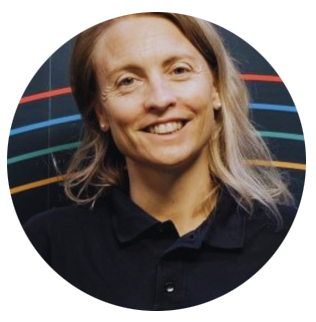
 Who are you and what exactly do you do?
My name is Natacha Callens. I am a physicist, and I work in the Education Department of the European Space Agency (ESA). I am based at ESEC, the European Space Security and Education Centre, located in Redu in Wallonia.
Within the ESA Academy unit, I help attract higher-education students to the space sector and prepare them for a future career in this field, complementing the training they receive in their academic institutions.
For the past two years, I have been in charge of the “Engagement” programme, which offers collaboration models both within ESA and with academia, the space industry, and various institutions. Together, these partnerships help prepare the talents of tomorrow by strengthening their knowledge, skills, and abilities through joint opportunities offered to students from ESA Member States and Associate States.
Most of my days are spent behind my computer or in meeting rooms, coordinating with my team on ongoing collaborations and exploring potential new opportunities. What I enjoy most, however, is meeting our partners and future talents, and engaging with them directly during events.
On one hand, the international and multicultural dimension of the work environment is extremely enriching. On the other hand, the diversity of our educational activities and the opportunity to lead projects from the initial idea to their operational implementation and then witness the benefits they bring to students are particularly rewarding.
The various administrative tasks and the lengthy processes that exist within this type of institution, but that is part of most jobs.
One day, in my school library in Brussels, I came across Space Connection, a magazine published at the time (and still now, under the name of Science Connection) by BELSPO. As I flipped through it, I was immediately captivated. That’s what inspired me to pursue scientific studies, with the goal of one day working in the space sector.
During my bachelor’s degree, I had the opportunity to complete an internship at ESA’s astronaut training centre in Germany. This experience was decisive: I promised myself that one day, I too would work for the Agency.
During my master’s, I completed a second internship in a laboratory at ULB in Erasme, where I analysed scientific data collected from astronauts. This encouraged me to undertake a PhD involving microgravity research. Thanks to the PRODEX programme for developing scientific experiments, I had the chance to take part in parabolic flights, contribute to a sounding‑rocket experiment, and collaborate with other European laboratories, space‑sector companies, and ESA representatives. These unique experiences were extremely valuable for my development as a young professional.
One day, I came across a job opening at ESA to develop an educational programme offering access to parabolic flights. I applied immediately, driven by the desire to offer others the experience that had shaped my own path.
Since then, I have progressed in my career but have always remained in the field of education, which remains at the heart of my commitment.
I began my studies with a Bachelor’s degree in Matter Sciences at Université Paris-Sud. I then continued with a Magistère in Fundamental Physics, completing the first year at the same university and the second year in Lisbon through Erasmus. I then pursued a one-year specialisation in Fluid Mechanics at Université Pierre et Marie Curie, again in Paris.
I completed my academic journey with a joint double PhD in Applied Sciences between Université Pierre et Marie Curie and Université Libre de Bruxelles.
My job requires a wide range of skills. Leadership, project management, and the ability to work effectively in a team are essential. Organisation, proactivity, and strong problem-solving abilities are indispensable on a daily basis. Finally, strong interpersonal skills, a well-developed professional network, and a keen sense of diplomacy are also major assets for successfully managing our collaborations.
Create your own opportunities.
Dare to take the leap and apply for a job in the space sector.
Belgium is a small country, but it has a great deal to offer in the development of the space sector in Europe.


