
 Who are you and what exactly do you do?
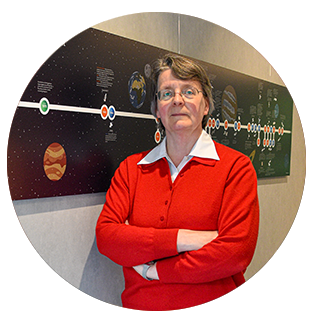
My name is Ann Carine Vandaele. After working for more than 30 years as a scientist at IASB-BIRA, the Royal Belgian Institute for Space Aeronomy, I became its Director General. I am now in charge of the management of the institute, the oversight of the administrative teams, the development of our research and management strategy, and deciding how our strategic objectives can be translated into the decisions and daily tasks of our support services and our scientists. At the same time, I try to stay involved in projects I previously worked on, linked to ESA planetary missions. As the head of a research institute, I must keep up to date with recent developments in the institute’s other research areas.
It is difficult for me to define a typical day; every day, there are unforeseen events, external requests, etc. which make no two days the same. In practice, my days often involve talking to department or division managers so that I’m aware of the latest developments, problems or successes, solving problems of all kinds (people-related, technical, etc.) and answering questions from colleagues. There are also meetings with stakeholders that I attend in my capacity as Director General, officially welcoming visiting international colleagues. I am a member of various expert committees, including at ESA, which allows me to stay up to date with the latest developments and to represent the IASB-BIRA as well as Belgium more generally.
What motivates me most is knowing that I am working to ensure that everyone at the IASB-BIRA can work in the most conducive and serene environment possible. I appreciate the discussions with my colleagues, scientists or not; I love learning and understanding my surroundings, so these discussions are essential for me. I follow some projects that are close to my heart, such as NOMAD on ExoMars Trace Gas Orbiter or VenSpec-H developed for the next ESA mission to Venus. I am also a visiting professor at UNamur, ULiège and Tohoku University in Japan. I will teach courses in planetology there, and I still supervise the theses of some Master's and PhD students.
A more delicate aspect, undoubtedly less attractive, is the management of conflicts between people. Fortunately, this happens very rarely, but each case is complex. Having to make difficult decisions, sometimes contrary to my own convictions, but justified by the difficult context in which we have been evolving in recent years, is not easy either.
I completed my PhD in partnership with the IASB-BIRA where I then developed the reference spectral measurement laboratory to improve the spectroscopic detection of atmospheric compounds. I was fortunate to be involved in the Venus Express mission thanks to the SOIR instrument developed at IASB-BIRA, whose purpose was to measure the chemical composition of the atmosphere of Venus. From there I created a research group focused on the study of the atmospheres of other planets and then became head of the division in which this group had developed. When the position of Director General for the IASB-BIRA became available, I submitted my application, and here I am!
I studied civil engineering in physics at the Université libre de Bruxelles, and my PhD focused on atmospheric science. I built an instrument that measured air pollution on the university campus. This work is an illustration of my later journey: using my engineering skills to develop instruments for observing atmospheres. I have always been concerned about the well-being of my colleagues, and I have taken several training courses in group management, project management, as well as training to become a trusted person within my institute.
I think that curiosity and the desire to understand and learn, on one hand, and empathy on the other hand, are the main skills. Of course, then, it is useful to know how to manage a group or manage a project, to develop more specific, administrative and technical skills, but if motivation is lacking, all this learning cannot be valued.
My only advice is to have confidence in yourself and not be afraid to take on challenges when they arise.


