
 Who are you and what exactly do you do?
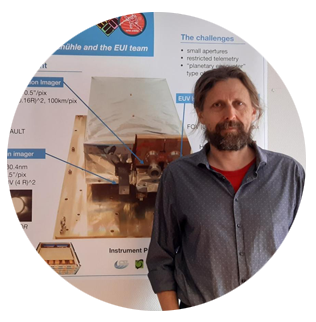
I am David Berghmans, a solar physicist at the Royal Observatory of Belgium. Together with my team, I manage the EUI (Extreme Ultraviolet Imager) space telescope, which observes the Sun’s atmosphere in detail. Through Belspo, significant investments have been made in this telescope. It is therefore our responsibility to make full use of that investment. This means asking: how can we collect the most valuable and distinctive observations to advance science? How do we ensure that these data reach the right researchers as quickly as possible? And what support do they need to use them optimally?
“Is the telescope still working?” is the first question my team and I ask ourselves in the morning. Once a day, we establish contact with the satellite (Solar Orbiter) and receive information about the telescope’s status and its activities over the past period. If any anomalies have occurred, they must be interpreted and we work out a recovery plan. Fortunately, this rarely happens, and on most days, we can start with an initial check of the new images. In addition, planning future observations is particularly time consuming. First, scientists must reach a consensus on which observations should be prioritised at any given moment, and how different solar telescopes can be coordinated. We then translate this into a concrete observation programme, which is sent to the EUI telescope as a series of commands. Finally, there is the actual research: thoroughly analysing specific observations with the aim of gaining new insights and ultimately publishing them in scientific papers.
Our EUI telescope delivers images of the Sun with unprecedented resolution and a wider field of view than ever before. This unique capability means we regularly observe structures and motions that have never been seen before and are therefore of great importance for further research. Every week, we hold a short teleconference with ten to twenty colleagues to review the latest data together. The moments when someone suddenly says, “Hey, what’s that strange wobble?” still give me the same tingling excitement I felt as a child opening a new Lego box: the sense that you’re at the beginning of something new.
I have a love hate relationship with the management side of my job. As a somewhat older scientist, it is logical that I take on more leadership tasks and manage a team. It is also very rewarding to give young colleagues opportunities, to entrust them with tasks they often do better than I do, and to see them grow in their roles. But management also brings responsibility: for the team’s well being, for their funding, and for a considerable amount of administration. Before you know it, that becomes your focus, leaving little time for the science itself.
After my studies in Leuven, I was determined to go abroad. However, shortly before completing my PhD,
an interesting temporary position opened up in Uccle, barely thirty kilometres away. What began as a
temporary job turned into a permanent position, and 29 years later, I’m still here.
A bit like the advertising slogan: “One day, you find the job of your life…”
I obtained my PhD in Science at KU Leuven in 1997, under the supervision of Prof. Marcel Goossens (Centre for Mathematical Plasma Astrophysics). My dissertation was a theoretical study of how plasma waves are generated in magnetic structures in the solar corona. So in terms of content, it’s not that far removed from what I do today, although now with a more observational approach.
It feels a bit strange to list my own skills, but I can say that everyone on my team is strong in mathematical/problem solving thinking, and comfortable with computers and programming. I enjoy working with people who are not afraid of complexity, but who can still see the bigger picture. In addition, a certain playful creativity is essential: the ability to ask “What if we tried it differently?” is often exactly what is needed to make real progress.
As a manager, I strongly believe that the best results come from people who feel good and free at work. By “feeling good,” I don’t mean that everyone has to become friends, but that there must be room for everyone’s individuality. Even if you’re not a super social person, perhaps more introverted or quirky, you can still make essential contributions. By “feeling free,” I mean that motivated people often work more efficiently when they can take initiative in organising their work and are not overly constrained by “rules from above.” There’s a saying that managing a team is a bit like managing a group of cats: the mice only get caught when you let the cats do their own thing.


