
The ARTES4.0 programme  is a long-standing backbone programme serving ESA Member States’ industry and institutions, supporting technology, product and service developments in satellite connectivity. The programme puts an emphasis on:
To realise these goals, the programme consists of general and strategic programme lines (GPLs, SPLs) each with a different focus area but a common set of rules.
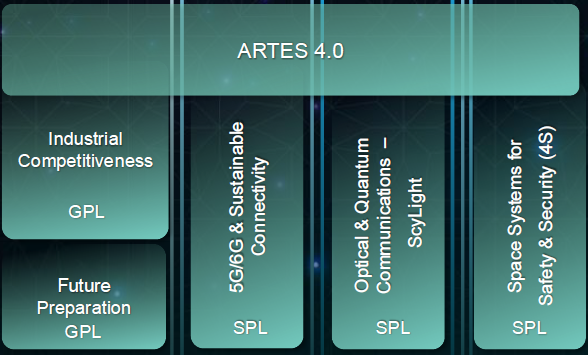
Schematic overview of ARTES4.0 GPLs and SPLs
GPL IC - Industrial Competitiveness
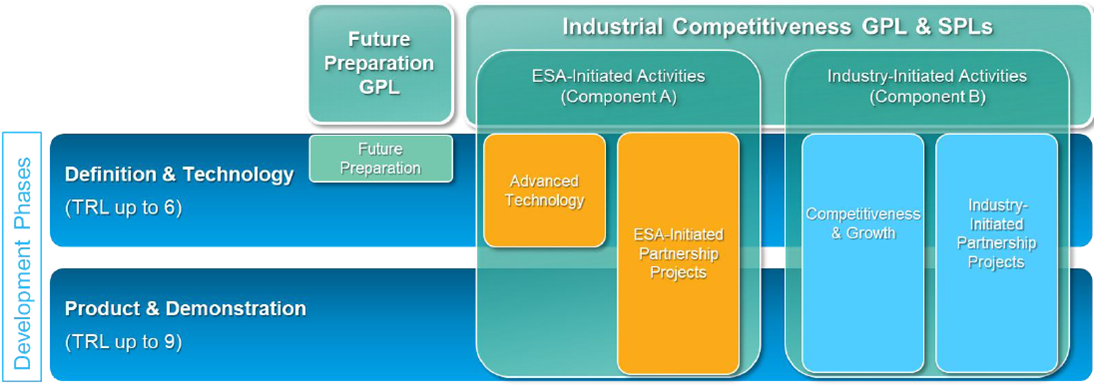
The new GPL Industrial Competitiveness integrates what were formerly two separate GPLs: the Partnership Projects and Core Competitiveness programme lines. With their integration, ESA strives to simplify the ARTES4.0 structure and improve flexibility. The Industrial Competitiveness programme line consists of:
Each of the three SPLs described hereinafter employs the same toolbox as the Industrial Competitiveness GPL. Each covers space, ground and user segments in the associated strategic domain. Belgium participates to all three SPLs.
SPL 5G – Space for 5G/6G and Sustainable Connectivity
The SPL 5G/6G supports development of products and services using 5G and 6G through the integration of satellite and terrestrial networks. The programme builds innovative hubs and testbeds, while drawing technology and product roadmaps. The SPL offers the same programmatic tools as the Industrial Competitiveness GPL, see above.
SPL 4S – Space Systems for Safety and Security
By working closely with user communities, institutions and industries with special attention given to reinforcing European supply chains, the SPL 4S transforms space technology into European or Canadian designed, manufactured and deployed operational systems that bolster non-dependence in a critical field for safer and more resilient societies. The SPL offers the same programmatic tools as the Industrial Competitiveness GPL, see above. Belgium is a participating state to the QKDsat Partnership Project under this SPL.
SPL ScyLight – Optical and Quantum Communications
The SPL ScyLight revolutionises connectivity on a global scale, kick-starting the development of disruptive optical and quantum technologies. The programme supports industry with research, initiates studies, plans pilots and defines critical technology roadmaps. The SPL offers the same programmatic tools as the Industrial Competitiveness GPL, see above.
GPL FP - Future Preparations
With the GPL Future Preparations , the aim is to ensure that ESA, industry and member states stay up to date with future development needs of the satcom sector. The programme line serves the following objectives:
Contrary to the other ARTES4.0 GPL and SPLs, FP does not provide a guaranteed return for member states, and more than half of the Member States subscriptions are used for ESA internal activities.
Most important changes w.r.t. CM22 ARTES4.0 programme
under the D/CIC, without impact on ongoing activities or significant changes to programme operations. Applications-type projects remain possible in ARTES4.0 SPLs also to allow industry to address downstream opportunities of ARTES4.0 developments. Such applications-type projects will be executed in close cooperation between D/CSC and D/CIC. Bram Van Droogenbroeck
Space Research & Applications


